Cartoons, cognac and cabin cruisers in charming Charentes

Visitors to Charentes will be bowled over, but it’s best to leave the brandy tasting until after lunch, as I discovered on a visit to Angouleme, Cognac and La Rochelle in France’s Nouvelle-Aquitaine region

La Rochelle’s Saint Nicolas Tower (left) and the Chain Tower guard the inner harbour

“Roll up, roll up – welcome to the town where Rizla cigarette papers were invented,” the road signs on the outskirts of Angouleme could read, but don’t. Perched on a plateau overlooking a bend in the Charente river, 130km north-east of Bordeaux (35 minutes from there by high-speed train), the town has other, less dubious claims to fame.

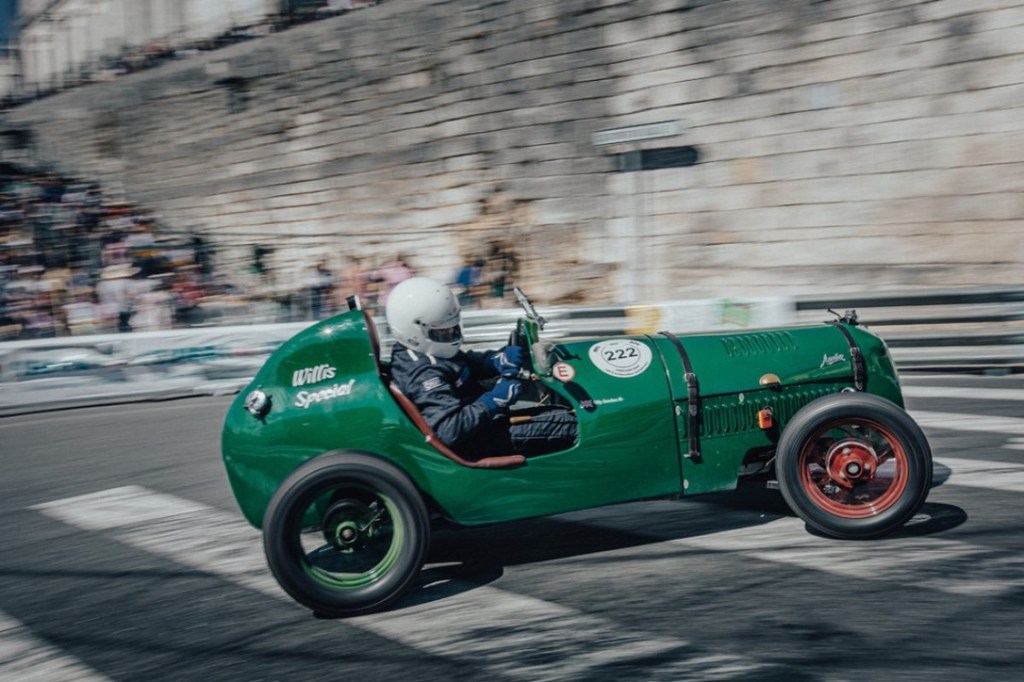
Its Circuit des Remparts classic cars rally, held every third weekend in September, was first staged in 1939 and attracts 65,000 enthusiasts from all over Europe; and each January, 200,000 fans attend the international comics festival, which has been a crowd-puller since 1974 – no surprise, given that one in four books bought in France is a bande-dessinée (graphic novel).

Thirty-odd permanent murals, some of them five storeys high, of superheroes, cartoon-strip characters and scenes from history provide a walking trail for fans of street art, guided by a free app. Many of them took weeks to complete, but on a bin shed door, a Banksy-style stencilled depiction of the Russian president wearing bright red lipstick was probably sprayed in a few seconds. The message beneath the image is the ultimate French insult – VLADIMIR PUTAIN.
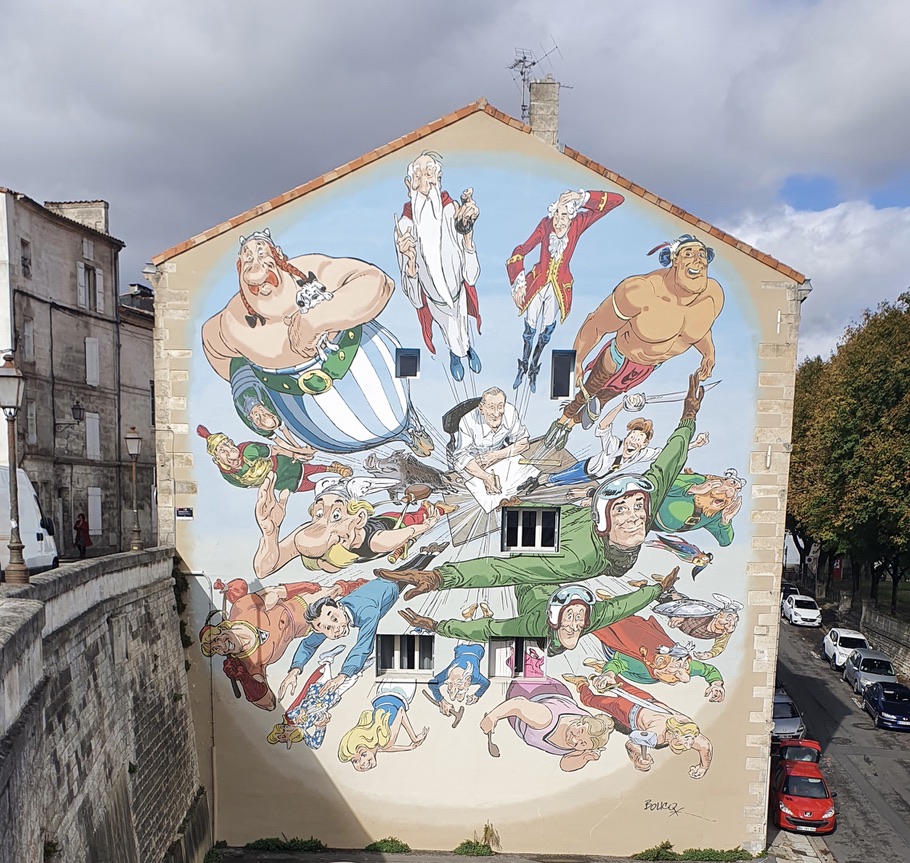
Angouleme is famed for its giant murals like this one depicting cartoon characters
A classic racing car competes in Angouleme’s annual Circuit des Remparts rally

In the treasury of the 12th-century Saint Pierre Cathedral, an extraordinary installation of coloured Murano glass by contemporary French artist Jean-Michel Othoniel has me mesmerised; so much so, it takes a combination of the curator jangling her keys and a gastric grumbling from my midriff to remind me the one-hour viewing is over and Sunday lunch awaits.

The 19th-century Marche des Halles is the culinary and social heart of the town, and amid the stalls offering fresh local produce are several street food-style bars with seating areas. At busy periods, affect a bad back and a sympathetic diner might slide along a bench and let you in – it works everywhere for me.

In Place New York, a plaque tells visitors that in 1524, Florentine explorer Giovanni da Verrazzano sailed into the Hudson during a voyage of discovery bankrolled by King Francis I, the former Count of Angouleme. A 16th-century portrait by Jean Clouet shows the French monarch, who was a patron of Leonardo da Vinci, had the head off Henry VIII – a fella who knew a thing or two about heads off.

The name Verrazzano gave to the land flanking the Hudson didn’t stick, or US musician Gerard Kenny’s 1979 hit would have been called Nouvelle-Angouleme, Nouvelle-Angouleme (So Good They Named It Twice), which isn’t so easy to sing.
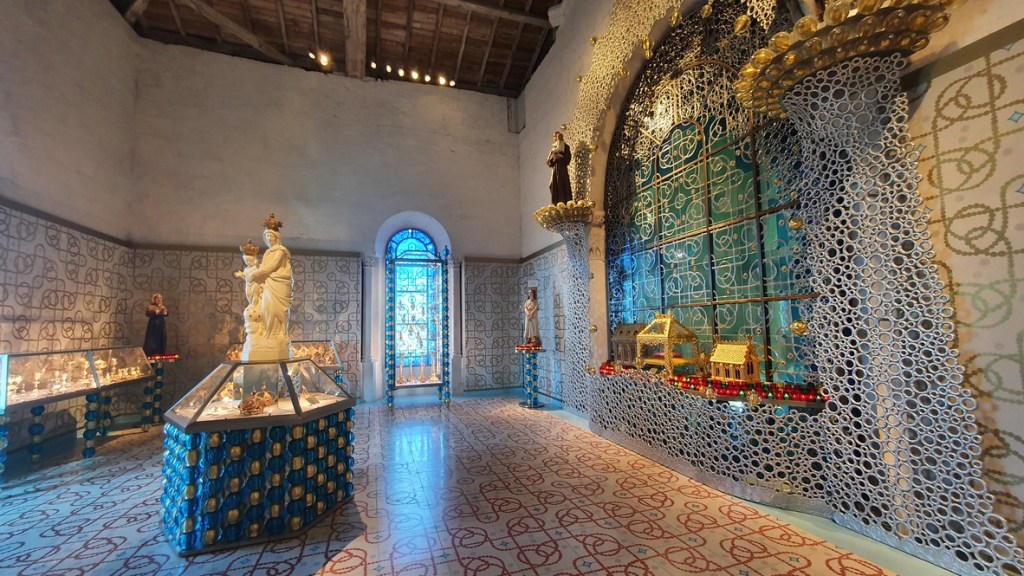
Part of Jean-Michel Othoniel’s remarkable installation in Angouleme’s Saint Pierre Cathedral

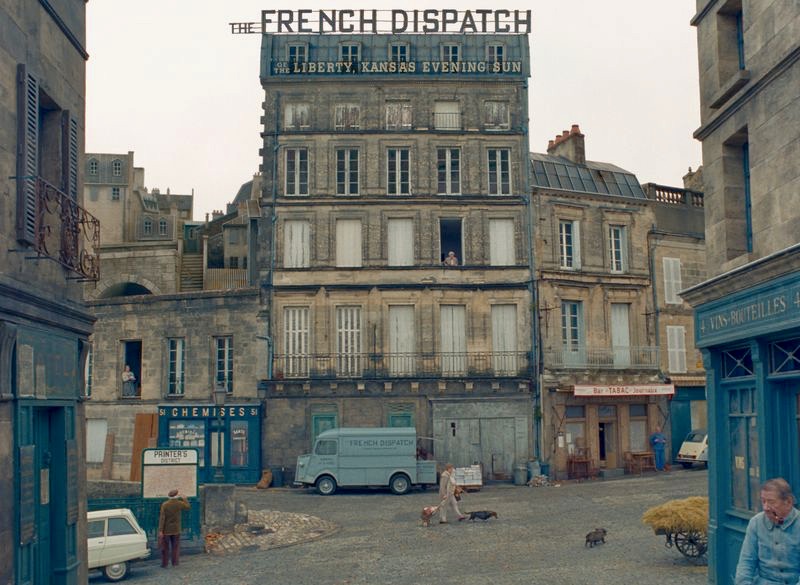
Wes Anderson’s whimsical 2021 movie The French Dispatch, which pays homage to The New Yorker magazine, was filmed in Angouleme and helped tourist numbers bounce back last year to pre-pandemic levels. For that reason, locals have forgiven the director’s little joke in renaming their town Ennui-sur-Blasé (Boredom-on-Apathy) on screen.

It helped, too, that Saoirse Ronan, who appears as a curly-wigged showgirl, sings France’s favourite lullaby, A La Claire Fontaine, to the kidnapped young son of the police chief. During the film’s premiere in Cannes, audience members who knew the words let out a nostalgic sigh and sang along.

In the four-star Le Saint Gelais hotel, staff remember the Hollywood stars who stayed there as tres charmant – and big tippers – and autographed photos of Frances McDormand, Adrian Brody, Benicio del Toro, Tilda Swinton and Willem Dafoe, among others, adorn the walls.

Bill Murray, who plays Dispatch editor Arthur Howitzer Jr and was required to be in Angouleme for only one day of filming, was so taken with the town that he remained for a week, frequenting its cafes and restaurants and playing golf.

Autographed photos of the stars of The French Dispatch in Angouleme’s Saint Gelais hotel
Many of Angouleme’s squares and streets were transformed by The French Dispatch designers

Formerly a priory, the 12-room Saint Gelais is a cosy first-night layover on my tour of the Charentes departments of the Nouvelle-Aquitaine region that proceeds to Cognac before ending in La Rochelle on the Atlantic coast.

Richard Hennessy, from County Cork, established his eponymous liquor-making business in Cognac in 1765 after serving with the Irish Brigade of Louis XV’s army, and among the brand’s famous fans was James Bond. In the 1969 film On Her Majesty’s Secret Service, 007 (George Lazenby) survives a bobsleigh crash shaken, not stirred, and tells a playful St Bernard dog to stop licking him and “go and get the brandy – five-star Hennessy, of course”.

Ninety-five per cent of all the brandy produced in and around Cognac is exported. Global sales leader Hennessy is especially popular among African Americans, thanks largely to its being the spirit of choice of Black hip hop artists and rappers, who have referenced it in nearly 1,000 songs. Cardi B, who has a sister named Hennessy, mentions the drink in her ‘nasty’ 2020 hit WAP. As Ms B has 154 million followers on Instagram, it’s a dream endorsement.

A tour of Hennessy’s riverside distillery and cellars, where 350,000 barrels are stored, is best left until after lunch as they pour with abandon during the tasting session. When you sell 70 million bottles a year, you can afford to be generous with the measures.

A hired cabin cruiser glides along the River Charente

It’s a mere hop, skip and a slight stagger from the Hennessy tasting lounge to the quay where the sightseeing boat La Demoiselle awaits passengers for a lazy 90 minutes on the water. Although early October, it’s sunglasses and T-shirts weather as a low-flying kingfisher whizzes past, its iridescent blue and orange plumage like petrol in a puddle. Visitors can see another colourful spectacle throughout July when fields full of sunflowers stretch from both banks of the river to the horizon.

A cabin cruiser like those for hire on Lough Erne and the Shannon glides by with a French family enjoying a mid-afternoon snack on deck. Cognac is one of three bases on the Charente where no-experience-needed captains and crews can board their boats for a weekend or longer on the 170 navigable kilometres from Angouleme to Rochefort, where the river meets the sea.

It’s on that sea a few hours later that I go for an evening cruise out of La Rochelle with skipper Bertrand de Rancourt on his 14-metre yacht Kelone and marvel at the most magnificent sunset I’ve ever seen. (One of my travelling companions was so impressed by the sight that as soon as he got home to Dublin, he booked flights to return with his partner the following weekend as a birthday treat.)
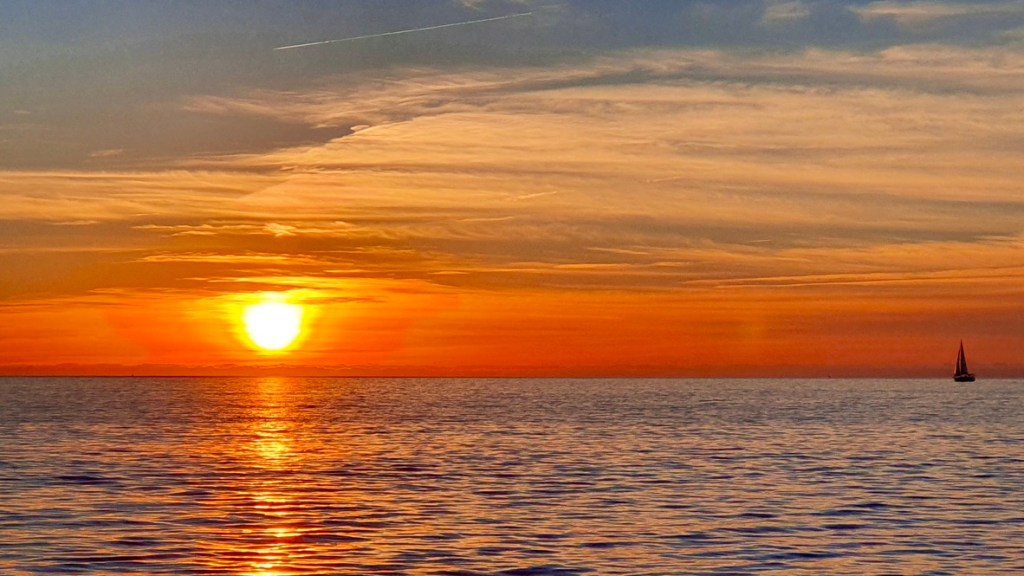
Glorious sunset off La Rochelle, as seen from skipper Bertrand de Rancourt’s yacht, Kelone

La Rochelle, where the Nazis built a U-boat base, has been no stranger to invasions, and was the last French city liberated by the Allies at the end of World War II. These days, the invaders are year-round tourists, plus the wealthy Parisians who own most of the multi-million-euro sea-view apartments to which they decamp each summer.

The main visitor attractions are the Saint Nicolas Tower, the Chain Tower and the Lantern Tower, which guard the entrance to the inner harbour and are together classified as a national monument.

As the name suggests, the 15th-century Lantern Tower was originally a lighthouse. From the 17th to 19th centuries it served as a prison, and the walls on all five floors are covered with graffiti, many examples left by Irish and English sailors and soldiers who were held there. They must have been the fittest – or most pooped – prisoners around, as they were forced to exercise by marching up and down the 158 internal steps several times a day.

Rumour has it that former Ireland rugby international Ronan O’Gara, the head coach of local Top 14 club La Rochelle, takes his players for secret training sessions on those same steps. That might explain why they’re one of the most physically imposing squads in the game, which helped them to back-to-back wins over Leinster in the 2022 and 2023 European Champions Cup finals.

Hire a bike and spend a leisurely day cycling on Ile de Re

The Marche Central provides all the charcuterie, cheese, fruit, bread and cheap but excellent local wine for a picnic on one of the city’s three beaches or those on nearby Ile de Re, where the O’Gara family live.

Many visitors hire bikes in La Rochelle and ride across the 3km-long road bridge to the island, which is 30km by 5km and mostly flat. Its 110km of safe and well-signposted cycle paths go past vineyards and salt pans, along the coast and through villages and small towns that are only a few kilometres apart, so you’re never far from a shop or a toilet.

Families with younger children prefer to use the shuttle buses that connect the city with the island communities, where bike-hire outlets abound. Another option, and great fun, is to board a shuttle boat to Ile de Re’s main harbour town, St-Martin-de Re – they leave from close to the three towers. Whichever way you get there, it’s an enjoyable day out that works up an appetite for dinner.

When you’ve ticked off all the sights to see in and around La Rochelle, chill out on the beach

An evening stroll through the narrow streets of La Rochelle’s old town or along the yacht-lined quays where German jackboots once stomped offers opportunities galore to dine on a restaurant terrace. Most bars are open until well past midnight year round, so there’s no need to rush your meal to catch a late-night drink or two on the way back to your hotel.

I’ve never heard of The Famous Pub on the waterfront, so I give it a miss and drop in to La Calhutte, where they’ve never heard of last orders, in a lively little square just around the corner from where I’m staying. Heading there, I pass a bus shelter with the route numbers on coloured discs on the side. They look like lottery balls, so I take a quick photo and add them to my EuroMillions slip.

To date, my twice-weekly investment in those numbers has cost me nearly €250 and returned a grand total of zero. However, when they do come up, I’ll celebrate with a big cigar (no Rizla roll-ups for me) and a glass of brandy – five-star Hennessy, of course – and ask Ronan O’Gara if he knows of any multi-million-euro sea-view apartments for sale.
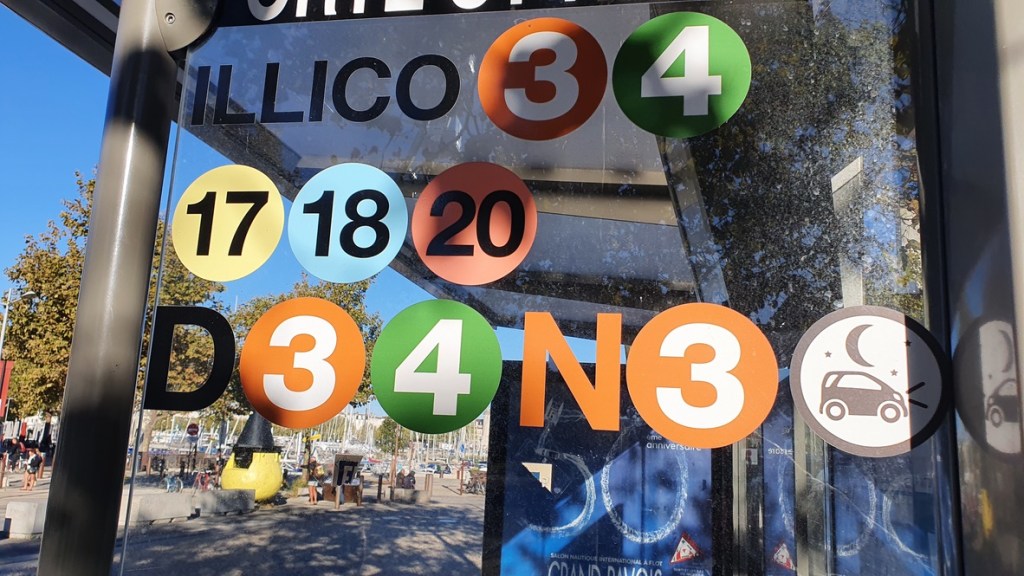
The unluckiest set of EuroMillions numbers on a bus shelter in La Rochelle

GET THERE

Ryanair (ryanair.com) flies from Dublin to Bordeaux and La Rochelle, while Aer Lingus (aerlingus.com) flies from Dublin to Bordeaux. If you aren’t driving, travel between Bordeaux, Cognac and La Rochelle by train (sncf.com)

STAY

I stayed in the 4-star Hotel Le Saint Gelais in Angouleme (hotel-saint-gelais-angouleme.com) and the 3-star Hotel Saint Nicolas in La Rochelle (hotel-saint-nicolas.com)

EAT

Angouleme: Les Sources de Fontbelle (sourcesdefontbelle.com), Marche des Halles (marche-halles.fr), La Cour (restaurant-lacour.com), Le Jardin des Arceaux, Hotel Mercure (restaurantsandbars.accor.com). Cognac: Le Bistro de Claude (bistro-de-claude.com). La Rochelle: La Yole de Chris (christophercoutanceau.com), L’Ardoise des Cloutiers (lardoise-des-cloutiers.fr)

THINGS TO DO

Hennessy distillery tour and tasting. See hennessy.com

Sunset cruise off La Rochelle. Three-hour private charter prices for one to 11 people range from €360 to €480 (with full complement of passengers, from €32.72 each). See kelone.fr

*I visited Charentes as a guest of angouleme-tourisme.com, atlantic-cognac.com, tourism-cognac.co.uk and holidays-la-rochelle.co.uk
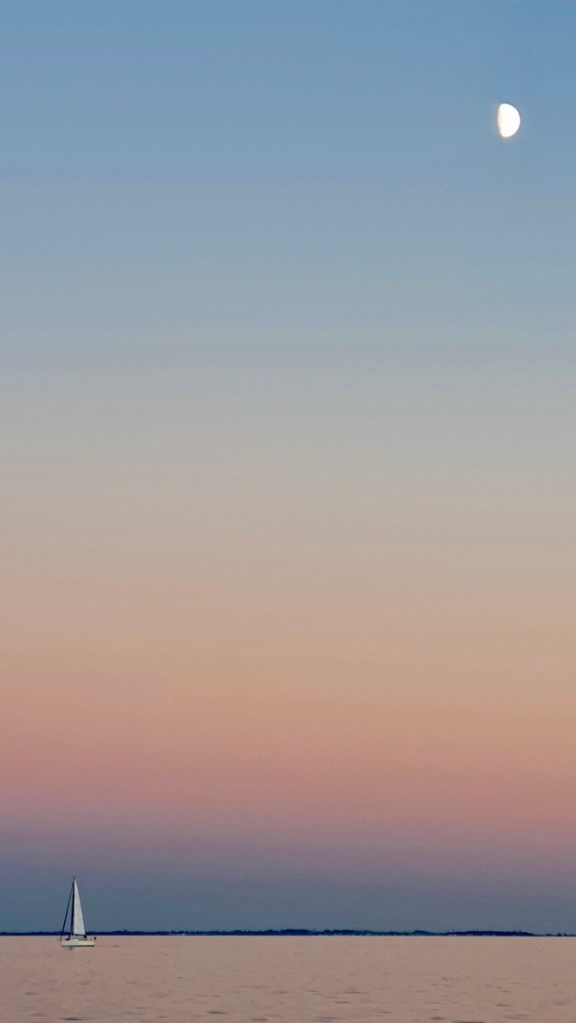
Dusk descends on La Rochelle

Collioure: Summertime, and the living is easel

The French Mediterranean resort town of Collioure has inspired artists for more than a century, which is no surprise — it’s as pretty as a picture. Located in the foothills of the Pyrenees, 30km from Perpignan and 25km from the Spanish/Catalan border, it’s well-to-do without being pretentious and, unlike the rip-off Riviera, is wallet-friendly. For a short break or a wind-down week, Collioure comes up trumps.

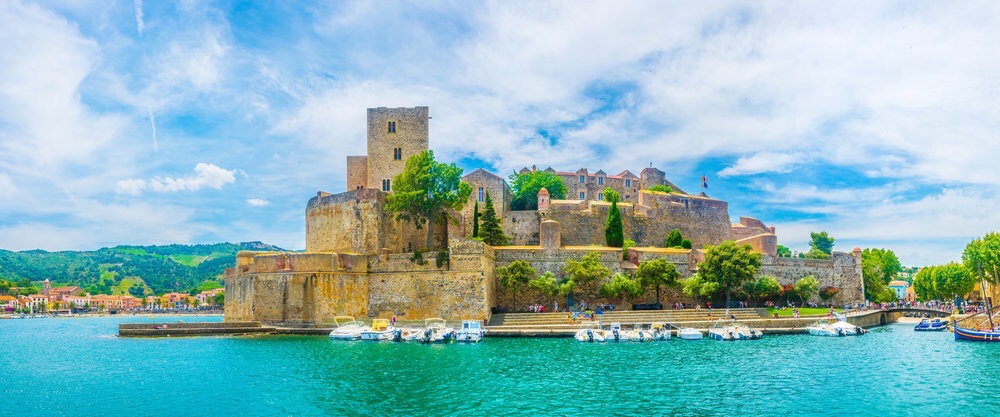
The Royal Castle, Our Lady of the Angels church and bell tower and one of Collioure’s four beaches

Henri Matisse and his fellow artist and friend Andre ‘I’m Singin’ In’ Derain put Collioure on the map. It’s a good thing they didn’t draw the map, as no one would ever find the place.

Matisse (1869-1954) and Derain (1880-1954), who spent two summer months here in 1905, were the founders of Fauvism, a style in which unmixed colours and unbridled emotion ruled — and to hell with perspective. This resulted in a lot of paintings that sort of look like what they were meant to depict.

When the impoverished pair left their shared beachfront studio to display their works at the Salon d’Automne in Paris, the art establishment was scandalised. “A pot of paint has been flung in the face of the public,” wrote critic Camille Mauclair in the bi-monthly Mercure de France. Louis Vauxcelles, in the daily Gil Blas, dismissed the artists as fauves — wild beasts — and said of their paintings: “I wouldn’t give one centime for any of these.”

Fast-forward 105 years to June 2010 when, at a sale by Sotheby’s in London, an anonymous buyer paid €22 million for Derain’s Arbres a Collioure (Trees in Collioure). In June 2018, Matisse’s Oliviers a Collioure (Olive Trees in Collioure) went for €3.4 million. Both paintings were completed in an afternoon.

Andre Derain’s Arbres a Collioure sold at auction for €22 million, proving money does grow on trees

The bar of Collioure’s Hotel Restaurant Les Templiers, the walls of which are covered with hundreds of original oils, most by long-forgotten artists, has seen many a sing-song over the years, having been a favourite hangout of Edith Piaf, Maurice Chevalier and Charles Aznavour when they were in town. Sacha Distel was another regular, and as I shelter inside from a rare June shower I can’t get the words of his 1970 hit single, Raindrops Keep Fallin’ on My Head, out of mine.

Matisse and Derain spent their evenings in Les Templiers; best buddies Pablo Picasso and Salvador Dali often shared a corner table; Winston Churchill added Cuban cigar smoke to the Gitanes and Gaulloise fug during his several painting holidays in Collioure and nearby Argeles-sur-Mer; and Princess Grace and Prince Rainier of Monaco were no strangers to the place, which will remind visitors from Dublin of Grogan’s Castle Lounge — the gallery that serves Guinness.

Les Templiers, which opened in 1895 as a cheap cafe for local fishermen, is run by the descendants of original owner Madame Pous. Her son, Rene, took over in the early 1920s, and he and his wife, Pauline, added the hotel and bar. They became great pals of Picasso and were kind to hard-up artists, allowing them to exchange canvases for food and drink in lieu of payment. Picasso gifted the couple many paintings, which for years took pride of place on the walls until several were stolen. The remaining originals were put away in a safe and reproductions now hang in the spaces they occupied.

Time for a coffee and a read of the morning paper in the bar of Hotel Restaurant Les Templiers

Patrick O’Brian, the author of the Aubrey-Maturin series of naval novels that includes Master and Commander, which was made into the 2003 Oscar-winning film starring Russell Crowe, lived for 50 years in Collioure, from 1949. He scribbled notes for his best-selling books in Les Templiers, where he became acquainted with Picasso (his 1976 biography of the artist is regarded as the best of the many written).

O’Brian went to great lengths to protect his privacy, and interviewers granted a rare audience had to promise not to mention Collioure and write only that he lived in the south of France. The Pous family and their staff always told visiting fans they had never heard of him — even when he was sitting within earshot at his favourite table — and townspeople would say they hadn’t seen him in years.

His real name was Richard Patrick Russ, which he changed by deed poll in 1945, and he passed himself off as an Irish Catholic born in Galway, although he was an English Protestant of German descent born in Buckinghamshire. O’Brian died a sad and lonely widower, aged 85, on January 2, 2000 in Dublin, and is buried with his wife, Mary Tolstoy Miloslavsky, who died two years before, in Collioure’s Nouveau Cimetiere.

Another grave of note, in the Ancien Cimetiere, is that of Antonio Machado. The Republican poet from Seville fled Spain in December 1938 before Franco’s thugs could put a bullet in his head, as they had done to his friend and fellow Andalucian intellectual, Federico Garcia Lorca, in Granada at the outbreak of the civil war in 1936.

As the Nationalist forces closed in on Barcelona, Machado and his 85-year-old mother left the city, crossed the border into France and found refuge in Collioure. It was a short-lived exile: Machado, who was in bad health, died aged 63 on February 22, 1939, and his mother drew her last breath three days later. They’re buried together in a plot that has become a place of pilgrimage for lovers of the poet’s work.

Art expert Cleo Dankert conducts one of her tours of the Fauvism Trail. Below, one of the pole-mounted brass picture frames through which visitors can see what Matisse and Derain saw

A more recent regular visitor to Collioure, when he had his health, was the late Northern Ireland peacemaker and Nobel Laureate John Hume. He was a friend of the late Dutch president of the European Parliament, Piet Dankert, who had a home here and whose actress daughter, Cleo, is an expert on Matisse and Derain.

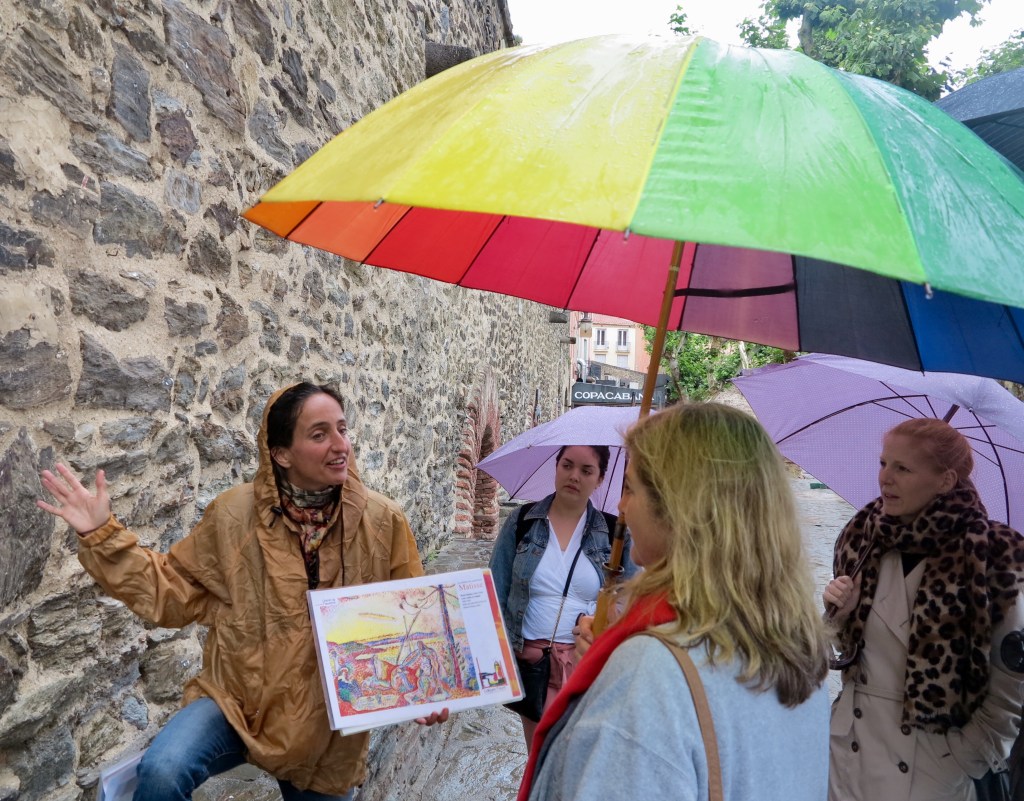
Cleo’s walking tours, which even those who don’t know their arts from their elbow will find fascinating, take in the Fauvism Trail and halt at the many spots where the two painters set up their easels side by side. Twenty wall-mounted reproductions of their works, which they rattled off at lightning speed (80 paintings each in eight weeks), allow tourists to compare the sights with what the artists saw all those years ago. A clever touch is the series of pole-mounted brass picture frames through which you can look at the little-changed views they committed to canvas.

Beach and fishing boat scenes abound, and the 13th century Royal Castle of the Kings of Mallorca and the nearby 17th century Church of Our Lady of the Angels are frequent subjects. The 16th century hilltop Fort Saint-Elme, which Brigitte Bardot tried unsuccessfully to buy (it’s owned by a local anchovy-canning tycoon), also features in many paintings.

The fun part of visiting the fort, from where the views of the bay more than justify Collioure being known as the Jewel of the Vermillion Coast, is the ride up and down on the little road train that passes terraced vines first planted in the sixth century BC by the Greeks, who established a trading port here.

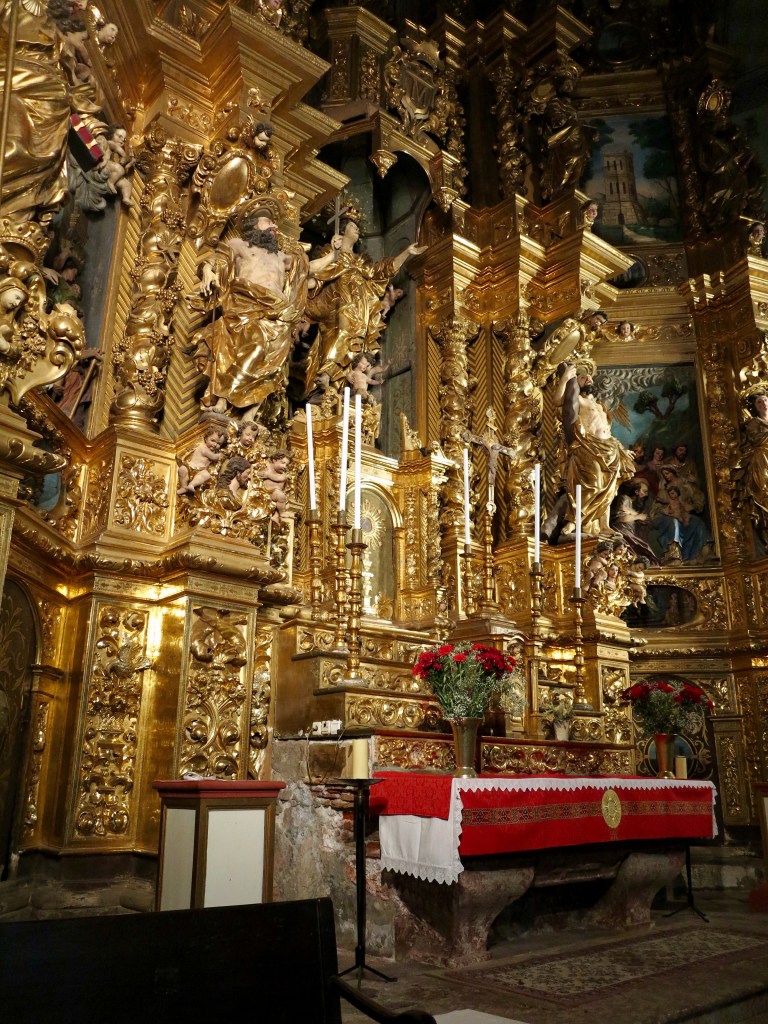
The Royal Castle of the Kings of Mallorca. Below, the gilded retable in Our Lady of the Angels

 “A picture must possess a real power to generate light,” Matisse wrote. Well, visitors to Our Lady of the Angels must possess a one euro coin to do the same — insert it in the electricity meter by the altar rail and the floor-to-ceiling gilded wooden retable is immediately illuminated. The work of master sculptor Josep Sunyer, it was completed in 1702 and is considered one of the finest examples of Catalonian Baroque carving.

With the Spanish border so near, the Catalonian influence is everywhere to be seen in Collioure. Yellow and red-striped flags from the independence-minded province next door flap on poles they share with tricolours, and street nameplates, billboards, shop signs and menus are in French and Catalan.

Before the dome on the church’s 30-metre-tall bell tower was added in 1810, this round structure, which dates from the 13th century and once stood alone surrounded by the sea, doubled as a primitive lighthouse and lookout post. At night, flames from a log fire on the top warned passing mariners to keep their distance from offshore rocks. In daylight, the town was alerted to hostile ships by acrid smoke spewing from burning rags and vegetation. Would-be invaders were a formidable enough threat, but the sentinels on the tower had to contend also with angry housewives who had just hung out a washing.

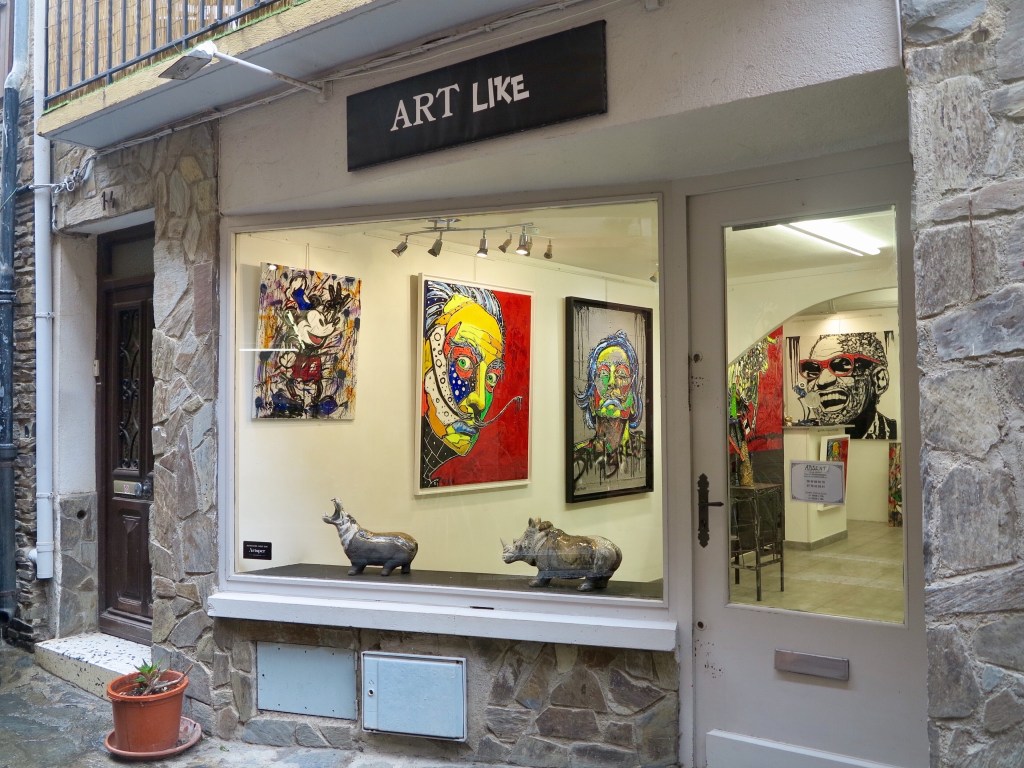
An artist at work in the sunshine. Below, one of Collioure’s 30 commercial galleries

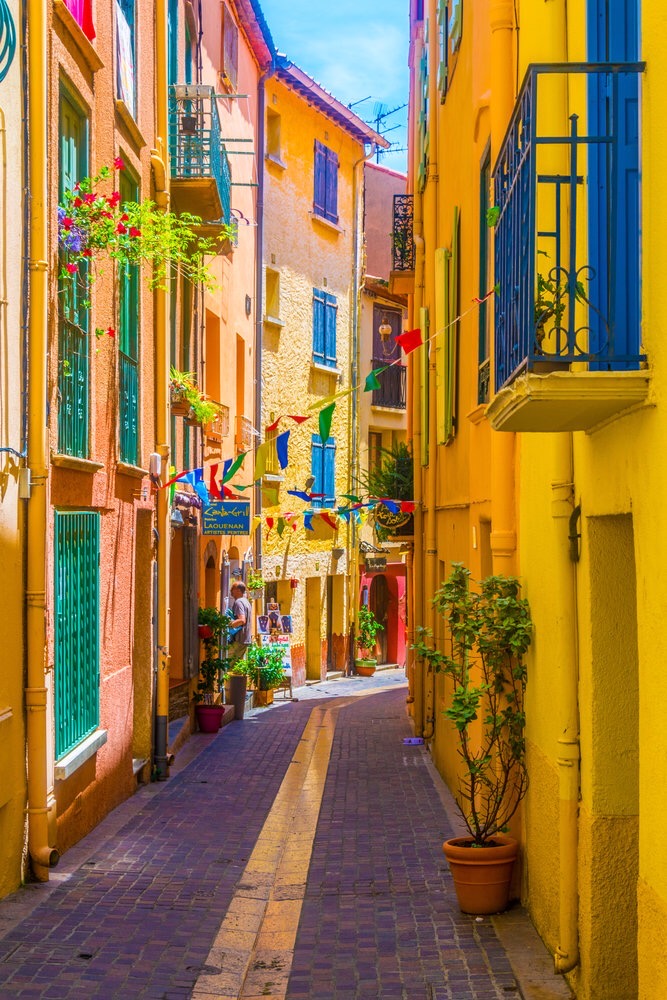
Although Matisse and Derain died nearly 70 years ago, Collioure has continued to attract artists. The town, which has a population of 2,650, is home to 30 commercial galleries — one for every 88 residents. There are dozens of studios, too, where painters, printmakers and ceramicists work, most of them in the mainly car-free narrow streets of the old Moure neighbourhood with its yellow and pink pastel facades.

Here, half-an-hour after the clouds drift off, steam rises from the pavements as the sun clocks on late and quickly makes up for lost time. Potted plants on balconies and hanging baskets overflowing with geraniums add a vivid splash of red against the now clear sky. “There is no sky so blue in all France,” wrote Matisse, which is why photos posted on social media take so long to upload.

Moure is where fishermen and their families once lived, in cottages bought and renovated in recent years by wealthy Parisiennes who occupy them only in the summer months. The few working fishermen still left, now apartment-dwellers in town, set out each night in their brightly-coloured little wooden boats to harvest the anchovies on which Collioure’s wealth was built.

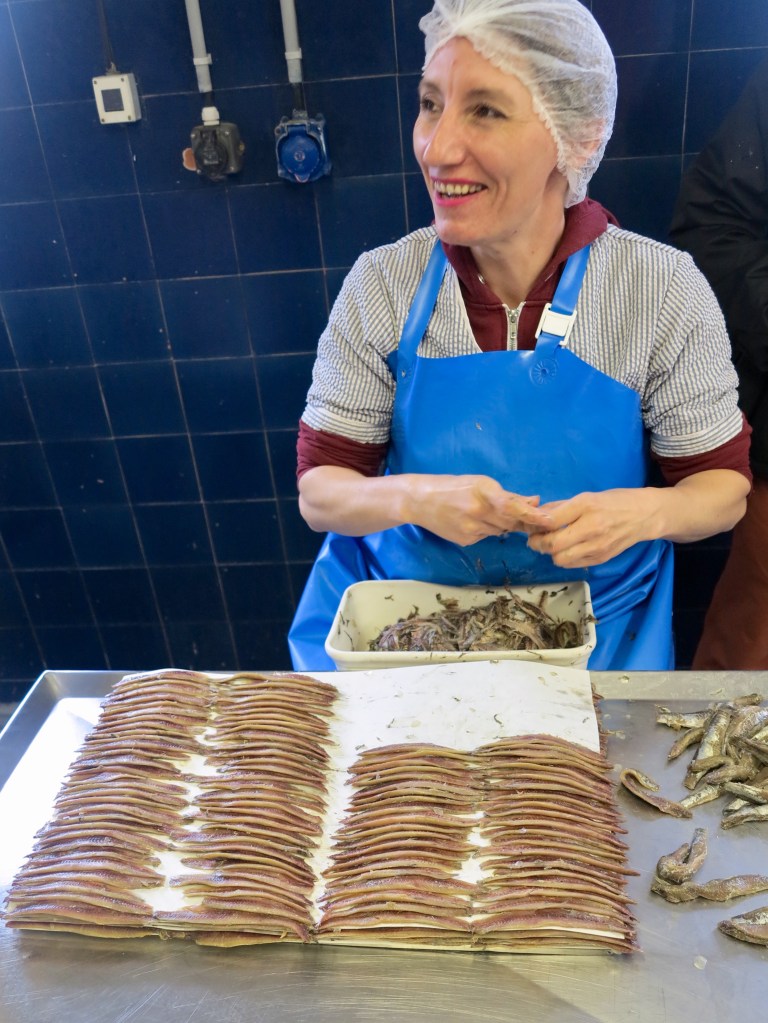
A visit to the Anchois Roque Collioure factory, a small family business established in 1870, is a pleasant, albeit pungent way to spend half-an-hour learning how these little fish are cleaned and filleted by hand by a small team of cheerful women who process thousands of them each day. The guided tour is free, as are the salty samples.

Happily hard at work in the Anchois Roque Collioure anchovy factory. Below, sports bar Cafe Sola

In Cafe Sola, where we seek to quench our anchovy-induced thirst, owner Laurent Puig-Sarbent has followed Les Templiers’ lead and covered the walls with portraits — of his football heroes. It’s evident from across the street where Laurent’s loyalties lie: on the awning over the terrace is emblazoned in Catalan the legend “Mes que un cafe” (“More than a cafe”), a take on FC Barcelona’s battle cry “Mes que un club”.

Inside, amid all the posters and branded souvenirs celebrating Barcelona greats past and present, is a faded black and white photo of Dubliner Patrick O’Connell who, as manager in 1936, rescued the Nou Camp giants from imminent bankruptcy (this was 12 months after he had steered no-hopers Real Betis to their first and only La Liga title, an achievement akin to Leicester City winning the English Premier League in 2016).

Born in Fitzroy Avenue, in the shadow of Croke Park, O’Connell (1887-1959) was the first Irish captain of Manchester United; however, it’s as the coach who defied Franco’s Civil War sanctions, set up a secret French bank account and took Barcelona on a lucrative tour of Mexico and the United States that he’s remembered and revered in the Catalan capital — and in Cafe Sola.

“Patrick O’Connell was our saviour,” Laurent says, and tells a waiter to bring a round of beers on the house “for my Irish friends”. Cleo opts for a small glass of the region’s sweet fortified wine as she has to head home to take delivery of some Ikea kitchen units. Making sense of the self-assembly instructions with a clear head would be challenging enough; with any more than a mouthful of Banyuls on board, Cleo’s new cupboards could end up resembling something Matisse or Derain cobbled together.

One beer leads to another, and cosy Cafe Sola begins to fill up with locals and tourists. There’s a great buzz about the place, and with no other plans for the evening, we decide to stay put. Eight o’clock becomes nine, and before we know it, it’s nearly 11.

There’s a Liverpool fan among us who’s itching to ask Laurent about the Champions League match the month before when Barcelona, 3-0 up from the first leg at home, were hammered 4-0 at Anfield. Nipping the mischief in the bud, we call it a night — before things start to get Messi.

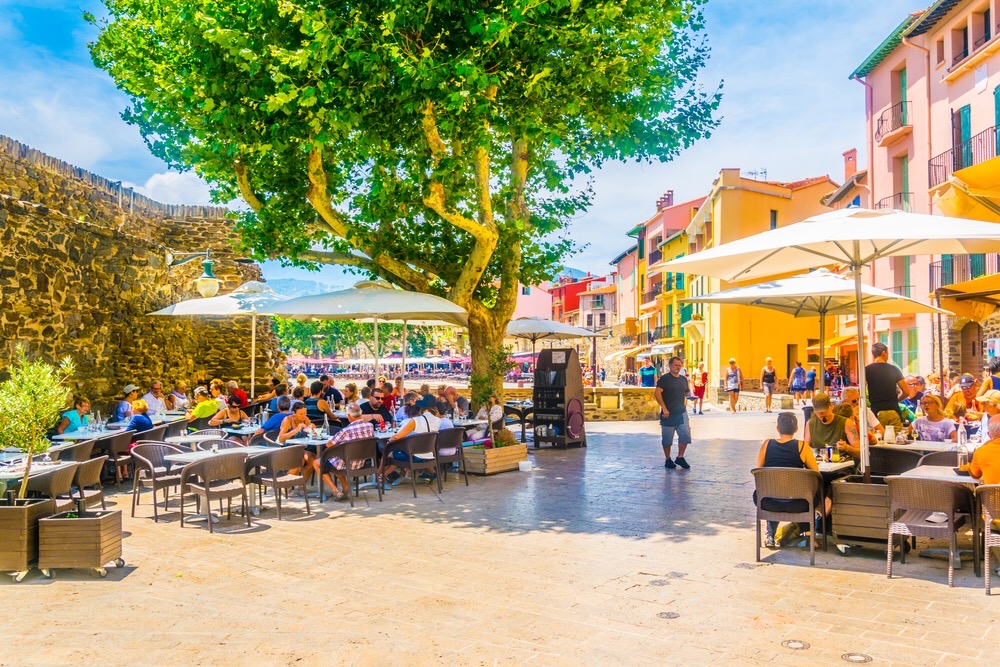
Outdoor cafe culture in Collioure. Below, one of the colourful streets in the town’s old Moure neighbourhood

GET THERE: In normal times, Aer Lingus operates up to five flights a week from Dublin to Perpignan, with fares from €59.99 one-way, including taxes and charges. Trains and buses connect Perpignan city centre with Collioure.

STAY: Three nights’ B&B in Hotel Mas des Citronniers, Collioure, costs from €178.50 per person sharing.

FURTHER INFORMATION: See visitcollioure.co.uk